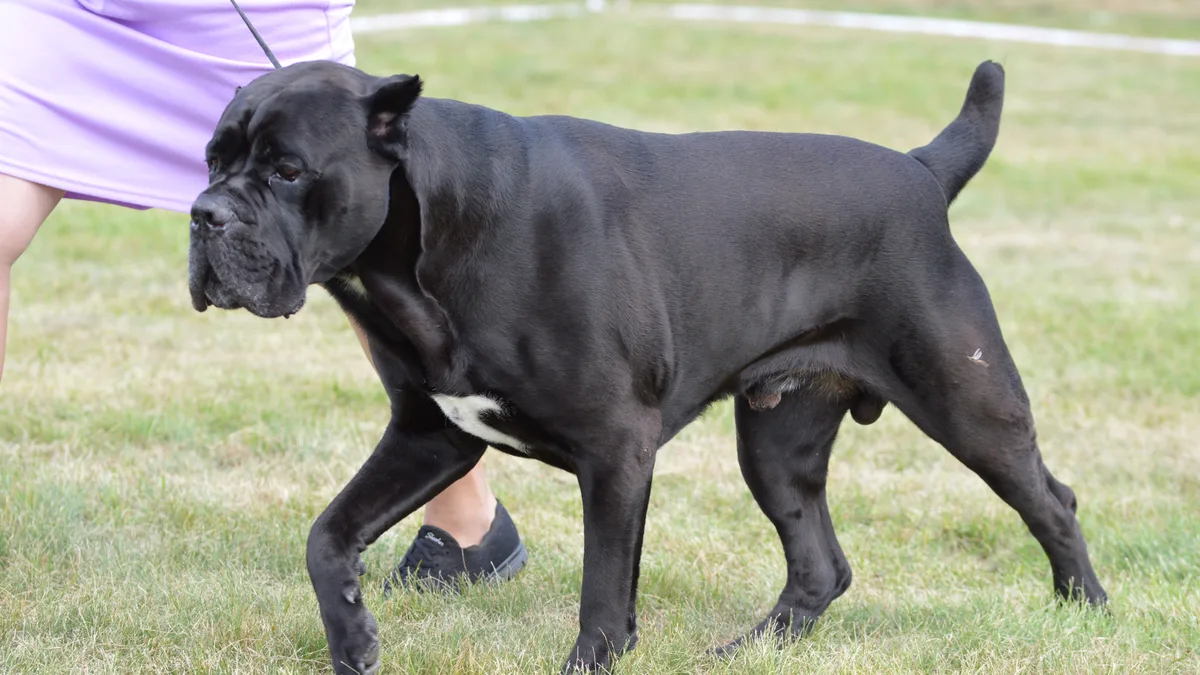
No — a well-bred, well-raised Cane Corso is not dangerous by nature, but this is a large, powerful guardian breed that asks far more of its owner than most dogs. According to the American Kennel Club (AKC), the Cane Corso is an assertive, confident protector, and according to PetMD, Corsi are intensely loyal to their families and reserved with strangers. The risk is never the dog alone — it is serious size, strength and guarding instinct, in the hands of an owner who skips the training and socialization that instinct needs.
Cane Corso quick facts
- Height: 25 to 27.5 inches (males) and 23.5 to 26 inches (females), according to the AKC.
- Weight: In proportion to height (AKC); often over 100 pounds, according to PetMD.
- Lifespan: 9 to 12 years, according to the AKC and PetMD.
- Coat: Short, double-layered, according to PetMD.
- Colours: Black, brindle, fawn, grey or red, according to PetMD.
- Temperament: Confident, loyal and reserved (AKC; PetMD).
- Group: Working (AKC); Guardian Dog (UKC); Group 2 (FCI).
- Originally bred for: Guarding (origin: Italy).
Breed standards and recognition
AKC (American Kennel Club). According to the AKC, the Cane Corso sits in the Working Group, fully recognised in 2010. The standard gives heights of 25 to 27.5 inches (males) and 23.5 to 26 inches (females) — and no fixed weight range: weight must be proportionate to height.
UKC (United Kennel Club). According to the UKC, the breed is registered as "Cane Corso Italiano" in the Guardian Dog Group, recognised on July 15, 2008 — two years before the AKC.
FCI (Fédération Cynologique Internationale). According to the FCI, the Cane Corso Italiano is standard No. 343, in Group 2 (Pinscher and Schnauzer, Molossoid and Swiss Mountain and Cattle Dogs), Section 2.1 (Molossian, Mastiff type), with origin Italy.
Where does the Cane Corso come from?
According to the AKC, the breed’s lineage runs back to ancient Rome, and its name translates roughly from Latin as "bodyguard dog" — in its native Italy, the job was protection.
What is a Cane Corso’s temperament really like?
According to PetMD, the breed’s temperament is "loyal and unwavering": Corsi are reserved, confident and attentive to their surroundings, tend to be quiet rather than noisy, with a sensitive, serious side from their working ancestry. PetMD notes they are intelligent and eager to please, but can be willful. The AKC describes the breed as smart, trainable and of noble bearing.

Are Cane Corsos good with families and children?
They can be, with the right family. According to PetMD, Corsi enjoy having a family with children to watch over — but the breed suits a family with older children best, because of its size; interactions with children and other pets should always be supervised, and children should be taught how to interact properly with dogs. PetMD also notes that Corsi like their family close by, ideally in the same room.
Families comparing guardian breeds often set the Corso beside the German Shepherd; our German Shepherd breed guide covers it in the same way.
How big and strong does a Cane Corso get?
According to PetMD, Corsi can weigh over 100 pounds and have large heads and a muscular appearance. A healthy adult may outweigh the person holding the lead — which is why manners must be installed while the puppy is still small.
One note, because this breed attracts exaggerated numbers: dramatic bite-force figures circulate online for this breed, but we could not trace any to a reliable source, so we leave them out.
Care
How much exercise and training does a Cane Corso need?
According to PetMD, Corsi require a good amount of exercise, benefit from frequent walks or runs and a fenced yard, and thrive on having a job to do — PetMD lists agility, skills training, dock diving and nose work. An understimulated Corso, PetMD warns, may get into trouble with digging, pawing and jumping.
Training is not optional with a dog this strong. According to PetMD, Corsi must be socialized and trained with positive reinforcement from a very young age, need consistent lifelong training, and do best with an experienced owner.
Why does socialization matter so much with a Cane Corso?
Because the breed starts out reserved. According to PetMD, early socialization and training are what help Corsi grow up accepting of new people, animals and situations. According to PetMD, much of a Corso’s behavior depends on the care and training it receives when young: gentle and affectionate in the right hands, but potentially reactive with an inexperienced or unkind owner — and an untrained Corso’s instinct to take charge is where problems start.
Our guide to Wolf-Dog Hybrids Explained makes the same point for another powerful animal: early, steady handling keeps strength from becoming a problem.
Do Cane Corsos shed a lot?
Moderately, and all year round — heaviest in spring. According to PetMD, the short, double-layered coat needs little maintenance. PetMD says baths are needed only a few times a year, or when the dog gets dirty — more often strips the coat’s natural oils. Ears should be checked weekly for redness or odor, according to PetMD, and nails trimmed regularly — if you can hear them clacking as the dog walks, it is time.
What should a Cane Corso eat, and how should meals be handled?
Feeding a Corso is partly a bloat-safety routine. According to PetMD, feed smaller meals through the day, not one large meal, avoid elevated bowls, and rest the dog around meals (see the health section below). Portions should also keep a giant breed lean: according to PetMD, obesity stresses the body and joints.
What health problems do Cane Corsos get?
According to PetMD, Corsi are generally healthy, and most breeders screen for common conditions:
- Hip and elbow dysplasia. According to PetMD, both are degenerative joint diseases and a common cause of pain in large and giant breeds, with signs such as limping and reduced range of motion as arthritis sets in. PennHIP testing can help predict lifetime risk.
- Bloat and GDV. According to PetMD, large, deep-chested breeds are susceptible to gastric dilatation-volvulus, in which the stomach fills with gas and twists — a life-threatening emergency whose warning signs PetMD lists as a stomach enlarging quickly, retching without bringing anything up, and signs of abdominal pain. PetMD stresses contacting an emergency veterinarian immediately; a preventive gastropexy (surgery fixing the stomach to the body wall) is often done at spaying or neutering time. (Meal precautions: see Feeding, above.)
- Eyelid problems. According to PetMD, Corsi are susceptible to entropion (the most common eyelid abnormality in dogs, in which the lid rolls inward), ectropion and cherry eye, which can cause chronic irritation and infection; surgery is the only correction.
- Idiopathic epilepsy. According to PetMD, this seizure disorder usually develops around three years of age; there is no cure, but seizures can be managed with medication.
- Demodectic mange. According to PetMD, this skin condition has a genetic predisposition and is seen particularly in puppies.
How long do Cane Corsos live?
According to the AKC and PetMD, the Cane Corso lifespan is about 9 to 12 years — a little longer than average for a giant breed, according to PetMD.

How much does a Cane Corso cost to buy and keep?
According to PetMD, a quality puppy from a reputable breeder costs about $1,500 to $2,500 on average, with top breed lines costing more. Budget honestly beyond that: a dog this size eats accordingly and needs a sturdy, well-fitting collar and lead for a very strong adult — our guide to how to choose the best dog collar covers fit and safety — and PetMD suggests prospective owners consider pet insurance, given the health list above.
Living with a Cane Corso — is it right for you?
The Corso suits an experienced owner with room to spare: according to PetMD, it does best with an experienced owner, is not a good fit for apartment living, and suits a big space with a large yard and a tall, sturdy fence. Families with older children can do well (see the family section above); first-time owners, and anyone who cannot commit to socialization and training from puppyhood onward, should choose a different breed.
Make the legal and insurance checks first: the dog ownership rules where you live, your lease if you rent, and your home insurance policy — ask whether the breed affects your cover.
So, are Cane Corsos dangerous? Not by nature — but they are a serious dog for serious owners. Choose a breeder who health-tests, start socialization and training the week your puppy comes home, and the breed’s famous loyalty is what you get. Skip that work, and you live with a very strong dog who makes his own decisions.
Frequently asked questions
Is a Cane Corso a good first dog?
Generally, no. According to PetMD, Corsi do best with an experienced owner who can provide early socialization, consistent positive-reinforcement training and plenty of daily exercise.
Are Cane Corsos aggressive by nature?
No. The breed’s recognised temperament is confident and protective, not aggressive: the AKC describes an assertive, confident protector, and PetMD a reserved, loyal dog whose behavior depends on its upbringing and training.
How big will my Cane Corso get?
According to the AKC, males reach 25 to 27.5 inches and females 23.5 to 26 inches, with weight in proportion to height — often over 100 pounds, according to PetMD.
Do Cane Corsos shed?
Yes — throughout the year, and heaviest in spring, according to PetMD.
Can a Cane Corso live in an apartment?
It is a poor fit — according to PetMD, the breed is not suited to apartment living and does best with a large yard and a tall, sturdy fence.
Photo credits: Wojciech Pędzich, Alandislands and Hughryanjh, all CC BY-SA 4.0, via Wikimedia Commons.
Leave a Reply